
Did you watch the opening races of the 2026 season with, at best, a polite smile, or at worst, a completely lost expression? Did you see blue lights flashing on the cars, hear the commentators talking about “Boost”, “Overtake Mode” or “Super Clipping” without understanding a single word, and end up nodding along as if you were following? Good news: you’re not alone, and we’re going to explain everything, from the very beginning, without unnecessary jargon.
Because yes, this year Formula 1 didn’t just tweak a couple of settings. It rebuilt everything: the engines, the aerodynamics, the weight of the cars, and even the vocabulary we use to talk about it. Here’s the complete guide, designed for beginners, so you’ll never be lost in front of your screen again.
First things first: why change the rules?
Before diving into the details, you need to understand why F1 decided to start from scratch. There are actually two main reasons.
The first is sporting. Over the last few seasons, teams mastered the old regulations (in place since 2022) so well that they all ended up converging in performance. The cars looked more and more alike, lap time gaps were becoming minimal, and the sport was starting to go in circles. When everyone has optimised the same formula to the maximum, it’s time to change the formula.
The second reason is industrial and environmental. F1 likes to present itself as a technological laboratory for mainstream automotive, and it must therefore remain credible in the eyes of manufacturers. With the automotive world’s transition towards electric power and cleaner fuels, F1 couldn’t stay with engines and fuels designed in 2014.
A quick reminder: the major eras of recent F1
To truly grasp the scale of the 2026 changes, a quick look back is needed. F1 has gone through several distinct technological “eras”:
- 2014: the switch to turbo-hybrid V6s : Before that, F1 cars used V8 engines. From 2014, F1 introduced 1.6-litre turbo V6 engines, hybridised with two energy recovery systems: the MGU-K (connected to the wheels, like an electric engine brake) and the MGU-H (connected to the turbo). This engine regulation remained stable for over ten years, and the architecture is dissected in our explainer on F1 engine specs.
- 2022: the return of ground effect : On the chassis side, 2022 marked a radical change: cars abandoned traditional flat floors for ground-effect floors, with Venturi tunnels underneath that literally “suck” the car down to the tarmac. This generates enormous aerodynamic downforce. The problem: ground effect also created the notorious “porpoising” phenomenon (cars bouncing on the track) and made cars very sensitive to the turbulent air from the car ahead, which complicates overtaking.
- 2026: the new revolution : And that’s where we arrive at today’s topic: new engines, new aero, new dimensions, new vocabulary. It’s the most profound change in over a decade.
Now that we have the context, let’s get to the heart of the matter: what has actually changed on the cars, and what do all these new words mean?
The 2026 engine: 50% petrol, 50% electric
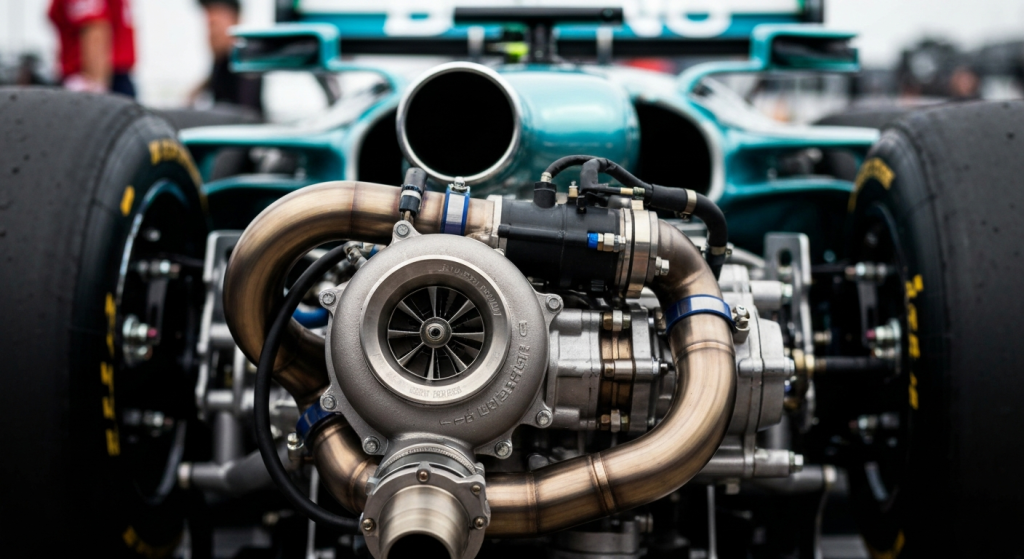
The biggest change of this new era is under the bonnet. The turbo V6s that have powered F1 since 2014 are still there in principle (a 1.6-litre combustion engine), but the way they work has been transformed.
Until now, electric power only represented a fraction of total power. In 2026, the goal is to achieve a 50/50 split between thermal power (the traditional petrol engine) and electric power (the battery). To get there, F1 has removed the MGU-H (the one that recovered energy from the turbo, very complex and costly) and significantly boosted the MGU-K, which acts at wheel level.
Another novelty: from 2026, all engines must run on 100% sustainable fuel, meaning fuel that doesn’t come from fossil petroleum. These are called “advanced sustainable fuels”.
This engine change has also reshuffled the deck on the manufacturer side: Ferrari and Mercedes obviously remain, but we see the arrival of Red Bull Powertrains (partnered with Ford), Audi (which bought the Sauber team) and the return of Honda. Cadillac, the brand-new team that brings the number of entries to 11 (and cars to 22, unseen since 2016), uses Ferrari power units while developing its own.
But having a powerful electric motor isn’t enough: you also need to know when to charge the battery and when to use that energy. That’s exactly what the new terms will help you understand.
Recharge mode: how the car fills up on electricity
First key concept: Recharge mode. As the name suggests, it’s simply the moment when the car fills up its electric battery.
There are several ways to recharge:
- Under braking: like any hybrid car, braking energy is recovered rather than wasted.
- At partial throttle, when the driver isn’t at full power.
- On “lift-off”: when the driver deliberately lifts off the throttle earlier than necessary to harvest energy. It’s the only form of recharge the driver truly controls manually, but it has a drawback: it simultaneously deactivates active aero (more on that shortly).
- In “Super Clipping”: this is arguably the most mysterious term on the list, yet the principle is simple. Super Clipping means recovering a bit of energy at the end of a straight, while the driver is still flat out (full gas). Unlike lift-off, active aero stays “open” since the driver hasn’t lifted.
Most of the time, it’s the car’s electronics (the ECU, the electronic control unit) that manages this recharge automatically, without the driver having to think about it.
The Boost button: the card the driver plays himself
Once the battery is charged, it needs to be put to use. That’s the role of the Boost.
Boost is a button the driver presses manually to decide, themselves, when to deploy their extra electric energy: to attack a rival, or conversely to defend their position. A press of the button switches the car to a maximum power setting (or a custom profile pre-selected by the team).
The driver can choose to use all that energy in one go, or spread it over an entire lap, depending on where they think they have the best chance of overtaking, or where they feel most vulnerable. The concrete result for spectators: overtakes will no longer happen only at the end of long straights as before, but potentially anywhere on the circuit, making races more unpredictable.
Overtake Mode: the DRS replacement
Now we come to THE big star of the new 2026 vocabulary: Overtake Mode (also sometimes called “Manual Override Mode” depending on the source). To understand it properly, you first need to remember what it replaces: the DRS (Drag Reduction System), the system that opened a flap in the rear wing to reduce drag and gain top speed, available only in defined zones on the track.
DRS is gone. In its place: Overtake Mode. The principle remains similar in spirit, but the technology is completely different. When a driver finds themselves within one second of the car ahead at a specific point on the circuit, they can activate Overtake Mode for the entire following lap: they then get a bit more electric power to use (and recover), with an additional 0.5 megajoule recharge and a dedicated power profile to maintain higher speed for longer.
The real difference from DRS is that the wing opening to reduce drag (the old role of DRS) is now available to everyone, all the time, thanks to active aero. What becomes exceptional and strategic in 2026 is no longer the wing opening — it’s the extra electric power reserved for the attacker.
Active aero: Straight Mode and Corner Mode (or X-Mode and Z-Mode)
Speaking of active aero, let’s talk about one of the biggest visual novelties of 2026. For the first time in the history of the sport, BOTH front and rear wings are permanently movable, adjusting automatically depending on the part of the circuit. To appreciate what that overturns, it helps to know how a fixed wing generates grip in the first place, which our primer on F1 aerodynamics lays out at the fence.
Two configurations exist (you may hear them under slightly different names depending on the media outlet — Straight/Corner or X-mode/Z-mode — but it’s exactly the same thing):
- Straight mode: the wing flaps flatten out to reduce drag and maximise top speed.
- Corner mode: the flaps return to their default closed position to generate more aerodynamic downforce and therefore more grip through the corners.
This is exactly what explains the famous flashing blue lights on the cars: they often indicate to other drivers and informed spectators when an electrical or aerodynamic system is activated (Boost, Overtake Mode…). Do not confuse them with the blue flag waved from the marshal posts, which means something else entirely — our guide to every F1 flag sorts out which blue is which. So it’s not just a visual gimmick: it gives you real-time information about what the car is doing.
Smaller, lighter, more agile cars
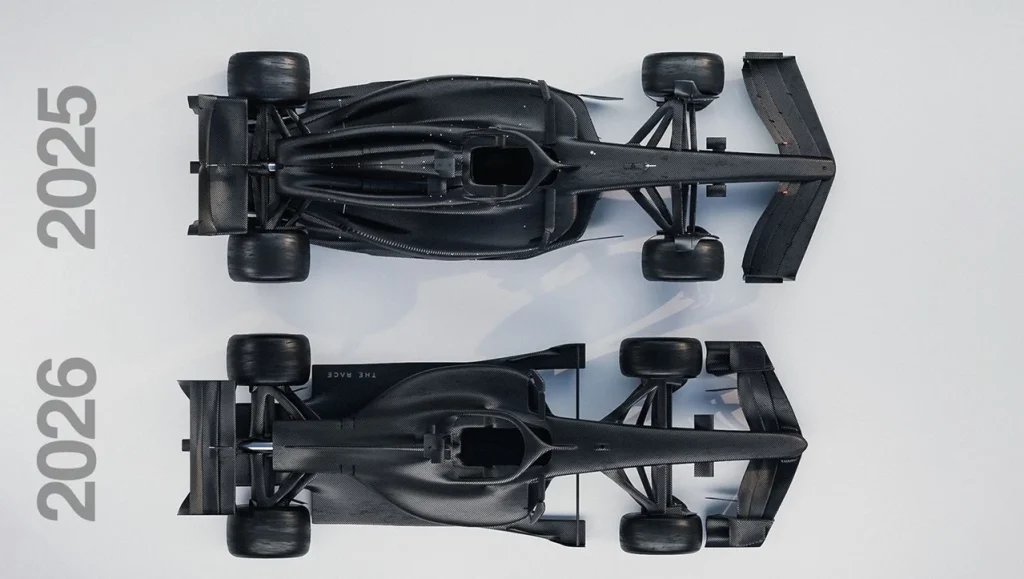
Beyond the engine and aero, the chassis itself has shrunk:
- The wheelbase (the distance between the axles) drops from 3.6 m to 3.4 m.
- The floor width decreases by 100 mm to reach 1.9 m.
- The Pirelli tyres are also narrower: −25 mm at the front, −30 mm at the rear, with a slightly reduced diameter too.
- The minimum car weight drops from 800 kg to 768 kg, roughly 100 kg less than a standard Fiat 500.
The goal behind all this: more nimble cars, easier to handle, less sensitive to the turbulent air generated by the car ahead (a real problem with the old ground-effect cars), to encourage closer wheel-to-wheel racing. The Venturi tunnels from ground effect are gone in favour of a flatter floor, and the wings are simplified with fewer elements, to reduce the air disturbance left in the car’s wake.
A small safety bonus: despite this slimming regime, safety steps up a notch, with more demanding crash tests (the vertical impact test on the roll hoop goes from 16 to 20 g) and a two-part car nose that continues to protect the driver even after an initial impact. These standards are the direct legacy of decades of F1’s worst crashes and the safety revolution they triggered.
What about the calendar? An 11-team grid
A small side consequence of all this novelty: with the arrival of Cadillac, we move to 11 teams and 22 cars on the grid, unseen since 2016. This doesn’t change the qualifying structure (still three phases, Q1, Q2, Q3), but the number of cars eliminated in Q1 and Q2 goes from five to six, to still arrive at a Top 10 fighting for pole in Q3. If the whole knockout ritual is new to you, our explainer on pole position and how qualifying works walks through it segment by segment.
The drivers speak out: why (and how) the rules have already changed mid-season
And here’s arguably the most interesting part for understanding the atmosphere of this early 2026 season: this new regulation, however carefully crafted, didn’t convince everyone from the very first Grand Prix. And the FIA had to adapt, fast.
From the first races, several drivers expressed their frustration, particularly on three points:
- Qualifying had become an energy-saving exercise rather than a true display of raw speed. Drivers had to manage their energy so precisely that taking risks in Q3 could paradoxically… make them slower.
- Energy management sometimes escaped the driver’s control. Lando Norris, for instance, explained after the Japanese Grand Prix that he hadn’t even intended to overtake Lewis Hamilton at a given moment: he found himself, in his own words, at the mercy of what the power unit decided to deliver on its own.
- The speed differentials between cars, particularly related to Boost and Overtake Mode, were deemed potentially dangerous, especially in the prospect of wet races, where these sudden speed differences could cause accidents.
Faced with this feedback, the FIA, F1 and the teams gathered (notably after the Chinese Grand Prix, then at an emergency meeting after the first three races) to adjust the regulations… without revolutionising them. The FIA’s Head of Single-Seaters, Nikolas Tombazis, emphasised that this was an “evolution” of the regulations, not a new revolution.
Here are the main adjustments that came into effect from the Miami Grand Prix:
- The maximum allowed recharge was reduced from 8 to 7 megajoules, to limit excessive energy recovery and encourage drivers to stay flat out longer rather than “saving” their lap.
- Super Clipping duration was shortened (between 2 and 4 seconds per lap), but its peak power was significantly increased from 250 kW to 350 kW. The idea: less time spent “nursing” the car, more time flat out, with a more predictable (and therefore safer) speed profile than some “lift and coast” manoeuvres previously used to recharge the battery.
- The number of circuits where reduced energy limits can apply went from 8 to 12, to better adapt to each track’s specific characteristics.
- The Boost power surplus was capped at +150 kW in races, to avoid overly brutal and therefore dangerous speed differences between two battling cars.
- Boost was simply banned in low-grip conditions (i.e. rain), on the same principle as DRS which was also disabled in the past on wet tracks. The FIA added a specific article to the regulations explicitly banning it under these conditions, again to limit dangerous speed differentials between cars.
Important to note: these adjustments don’t change the overall philosophy of the 2026 regulations (still no traditional DRS, still active aero, still Boost and Overtake Mode). They mainly correct excessive “calculation” in qualifying and situations deemed too risky on track, without reinventing the whole thing. And the FIA itself specified that this was an ongoing process: further adjustments cannot be ruled out as the season progresses, if new problems arise.
In summary: your survival glossary for following F1 2026
To keep it simple, here’s what you need to remember next time you watch a race:
- Recharge = the car fills up on electricity (under braking, on lift-off, or via Super Clipping at full throttle).
- Super Clipping = a discreet recharge at the end of a straight, without lifting off.
- Boost = the button the driver presses themselves to deploy extra electric energy, wherever they want on the circuit.
- Overtake Mode = the DRS replacement, giving extra electric power for an entire lap to a driver close to the car ahead.
- Active aero (Straight/Corner or X/Z-mode) = the wings that open on straights for more speed, and close in corners for more grip.
- The little blue lights = a visual indicator that these various electrical and aerodynamic systems are active.
There you go — you now know (almost) everything you need to follow an F1 2026 race without looking lost in front of your TV. And the good news is that even the drivers needed a few races to get used to all this novelty!